
Searching Kerr County Criminal Dockets
Begin with Kerr Odyssey Public Access, the official entry point. Pick Criminal Case Records there. Skip Jail Records, Jail Bond Records, Law Enforcement Records, and Incident Records, since those track arrests and incidents rather than the court docket itself. A case number is the strongest search key. Searching by name alone? Narrow it with the court, case type, or filing period, then confirm the result is truly a Kerr County case.
Online access is only one channel. For anything time-sensitive, check the court-specific PDF and call the clerk. District felony questions go to the District Clerk at 830-792-2281. Misdemeanor questions go to the County Clerk at 830-792-2255. You can also file a narrow copy request for delivery or pickup. re:SearchTX covers some filings and hearings, but it is not the main local criminal portal.
- Open Odyssey and select Criminal Case Records.
- Search by full case number, or by name plus court details.
- Identify a district felony or county misdemeanor.
- Compare the case with the right arraignment, jail, sentencing, or trial list.
- Ask the proper clerk for a plain or certified copy when needed.
Kerr Criminal Case Number Clues
Case numbers offer the first routing clue in Kerr County. The District Clerk uses A or B to start felony numbers, and County Clerk guidance marks misdemeanors with CR. Beyond that, the full year-and-sequence format is not published, so treat the prefix as a hint rather than a rule. Pull the exact case number from a notice, bond paperwork, or a portal result before you dig deeper.
Names alone are a weak way to search court records. People share names, and spellings drift. Anchor your docket search with at least two more facts, such as the court, the filing year, the case type, or the full number. When nothing comes back, the cause could be a brand-new filing, a lag in updates, a sealed record, an expunction, or simply the wrong category.
Inside a Kerr County Criminal Docket
The 198th and 216th arraignment lists can show a lot: court, date, time, case number, caption or defendant, charge, counsel, and setting type. The 198th version stresses arraignments. The 216th can blend arraignment, pretrial, and plea work. Remember that each list is just a setting list, not the full case file.
| Court and date | The issuing court and scheduled day, subject to a reset or venue change. |
|---|---|
| Case number | The key used to connect the row with the clerk index. |
| Charge | The filed allegation, not proof that the conduct occurred. |
| Setting | Arraignment, pretrial, plea, trial, sentencing, jail docket, or show cause. |
| Counsel | Appearance information that may change after the list is made. |
| Disposition | The case outcome, which must be verified in the clerk-held record. |
Kerr Criminal Setting Lists
Kerr County publishes several separate lists rather than one master criminal calendar. District sources split arraignment, sentencing, jail, jury, and show-cause settings. County Court at Law sources add bench trials, contested motions, motions review, pretrial conferences, sentencing, and show cause. Read the label closely, because a scheduled hearing is not an outcome.
- Arraignment
- A setting where the charge is addressed and a plea may be taken.
- Pretrial
- A court event for motions, readiness, scheduling, or case management.
- Show cause
- A setting to explain why the court should or should not take a stated action.
- Jail docket
- A list focused on matters involving people held in custody, not a jail roster.
- Disposition
- The recorded outcome, which must not be guessed from a hearing label.
Local rules put the 198th grand jury generally on the fourth Tuesday and the 216th on the third Monday. Those patterns are habits, not guarantees that any named case will appear on a given day.
How a Criminal Case Moves
A criminal case in Kerr County moves through a sequence, and the docket records each step. A filing may lead to arraignment, pretrial settings, motions, a plea or trial, disposition, and sentence. A continuance only moves a date; it decides nothing. Dismissal is not acquittal. Deferred adjudication does not automatically bring expunction or nondisclosure.
Docket flow: Filing › Arraignment › Pretrial › Plea or Trial › Disposition › Sentencing
Setting a new court date follows a routine under the local rules. Counsel contacts the coordinator and seeks an agreed date. Counsel files a marked motion with a proposed order, and gives contact details plus a time estimate. An incomplete order can sit unset rather than get scheduled. A phone conversation is not always the final word.
Kerr Criminal Clerks and Copies
Two clerks split the criminal files in Kerr County. The Kerr County District Clerk holds district felony pleadings for the 198th and 216th courts, while the County Clerk keeps County Court at Law misdemeanor files. When you request copies, name a specific instrument, a date range, and the copy type you want rather than every record tied to a name.
View the District Clerk source for Kerr County criminal records, which names the office that holds the files and its current access notice for the public.
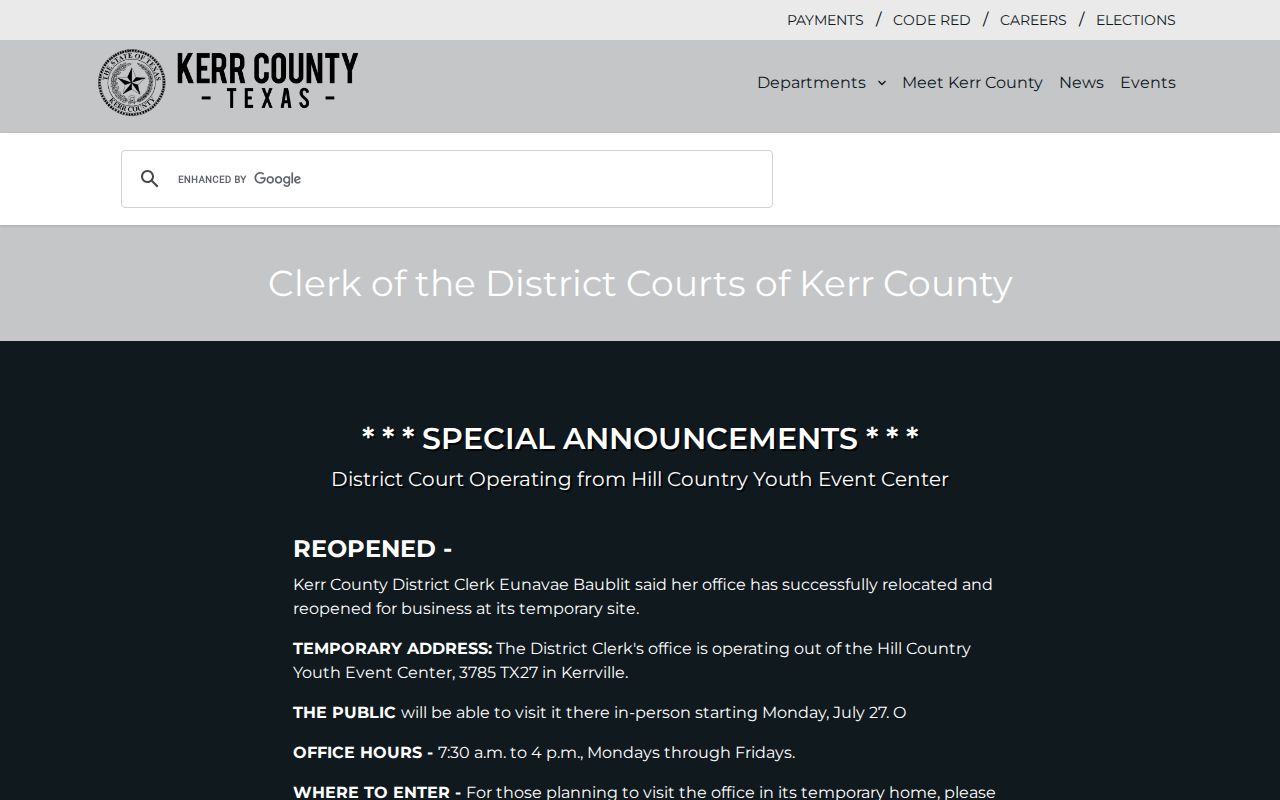
That notice is a reminder to check three things separately: the docket date, the filed image, and the office route. Treat each as its own fact.
District felony records
Kerr County District Clerk
830-792-2281
Normal hours are 7:30 a.m. to 4 p.m. Call before travel during courthouse repairs.
County misdemeanor records
Kerr County Clerk
830-792-2255
Normal hours are 8 a.m. to 4:30 p.m. Confirm location, cost, and payment before pickup.
Courts That Hold Criminal Dockets
Felonies land in the 198th and 216th Judicial District Courts, which hold those felony dockets. County Court at Law hears the misdemeanors. Fine-only Class C matters may go instead to a Justice of the Peace court, or to the Kerrville or Ingram Municipal Court. Read the court named on your ticket or paperwork before you search, since the docket sits with that court alone.
| Matter | Court route | Custodian |
|---|---|---|
| Felony | 198th or 216th District Court | District Clerk |
| County misdemeanor | County Court at Law | County Clerk |
| Fine-only county citation | JP precinct on citation | JP court |
| City Class C matter | Kerrville or Ingram court | City court |
This split keeps jail, incident, city, and county data from being mistaken for one Kerr County criminal docket.
Kerr Criminal Docket Venue Checks
Severe flooding in July 2026 uprooted normal court operations. The District Clerk moved public access to the Hill Country Youth Event Center. The address is 3785 Texas Highway 27. District criminal settings sometimes went to JP2 or to alternate counties. County Court at Law misdemeanor hearings were listed in Room 101 of the event center. None of that was permanent, so treat those arrangements as temporary conditions.
Before you drive anywhere, compare the newest list with the signed setting order. Then call the right coordinator. District questions route through 830-792-2290. County Court at Law questions route through 830-792-2207. A stale PDF can still carry the old courthouse address even after a venue change.
Confirm before travel. A relocation can change the hearing site without changing the underlying Kerr County case or clerk file.
Sealed Dockets and Public Access
Many Kerr County criminal entries are public, but access has limits. Texas Family Code Chapter 58 restricts juvenile information. Expunction falls under Code of Criminal Procedure Chapter 55A. Protected victim data, Social Security numbers, birth dates, medical details, and sealed filings must never be republished.
Texas access boundaries:
Family Code Chapter 58 protects juvenile justice information.
Code of Criminal Procedure Chapter 55A governs qualifying expunctions.
Texas courts open-records policy distinguishes case records from other judicial records.
An arrest is not an indictment. A charge is not a conviction either. A docket setting shows guilt of nothing, a jail record proves nothing, so confirm the true outcome with the clerk before drawing any conclusion about a Kerr County case.
Kerr Criminal Record Copy Costs
Older Kerr County fee schedules put plain copies at $1 per page, certified copies at $5 per certified document plus page charges, and email or fax at $2. Newer schedules can replace those figures. Ask the clerk to quote the full total before you pay. A good copy request spells out the court, the full case number, the exact filing, the date range, the copy type, and how you want it delivered. Include your phone and email so staff can reach you. District Clerk payments list Bureau 3580138 with card charges; County Clerk misdemeanor payments use Bureau 8088171. Paying is not proof. Money changing hands never cancels a setting or closes a case. Name the document, not just the hearing. Maybe you need the filed charging instrument, a signed order, or the disposition rather than an arraignment-list entry. Say whether an electronic, plain paper, or certified copy will serve your purpose. Ask if the file sits offsite and whether lawful redaction could slow delivery. A tight request saves the clerk from guessing which part of a Kerr County criminal docket you actually need. Misdemeanor payment rules sit apart from copy fees. County guidance takes cash, cashier's checks, money orders, and cards under stated terms, but checks are not accepted by mail or in person. Card vendors may add their own charges. Confirm the method and total with the County Clerk. A paid balance does not erase a setting, pull back a warrant, or settle the final disposition. Those answers come from the court itself.